Performance Marketing vs Traditional Marketing: Which Strategy Works Better in 2026?
The marketing industry has changed dramatically over the last few years. In 2026, businesses are no longer relying on just one method to attract customers. Instead, brands are exploring both digital and offline approaches to stay competitive in a crowded market.
One of the biggest discussions today is performance marketing vs traditional marketing. Business owners, startups, and marketers often ask which strategy delivers better results and where they should invest their budget.
The answer is not completely straightforward because both methods serve different purposes. However, understanding their strengths, weaknesses, and practical applications can help businesses make smarter decisions.
In this article, we will explore the complete comparison between performance marketing and traditional marketing, how both strategies work, and which one is more effective in 2026.
What is Performance Marketing?
Performance marketing is a digital advertising strategy where businesses pay only when a specific action takes place. These actions may include clicks, leads, purchases, app installs, or conversions.
Unlike traditional advertising, performance marketing focuses heavily on measurable outcomes and real-time campaign tracking.
Some common examples include:
- Google Ads
- Facebook and Instagram Ads
- Affiliate Marketing
- Influencer Campaigns
- YouTube Advertising
- Search Engine Marketing
One of the biggest advantages of performance marketing in 2026 is its ability to track every aspect of a campaign. Businesses can measure customer behaviour, monitor engagement, analyse conversions, and optimise campaigns instantly.
Major Benefits of Performance Marketing
The benefits of performance marketing have made it one of the most preferred strategies for modern businesses.
1. Measurable Results
Businesses can clearly track how much money is spent and what results are generated from that investment.
2. Better Audience Targeting
Advertisers can target users based on age, location, interests, online behaviour, and purchasing habits.
3. Budget Flexibility
Campaigns can be started with small budgets and scaled gradually according to performance.
4. Faster Results
Businesses can generate traffic, leads, and sales quickly compared to many offline methods.
5. Real-Time Optimisation
Performance marketing allows brands to pause, adjust, or improve campaigns immediately.
What is Traditional Marketing?
Traditional marketing refers to offline promotional methods that existed long before digital platforms became popular.
These marketing methods focus mainly on mass communication and brand visibility.
Examples include:
- Television advertisements
- Newspaper advertisements
- Radio promotions
- Billboards
- Flyers and brochures
- Magazine advertisements
Traditional marketing still plays a strong role in building credibility and increasing public awareness, especially among audiences who consume offline media regularly.
Although digital marketing is growing rapidly, traditional marketing continues to influence customer behaviour in many industries.
Performance Marketing vs Traditional Marketing: Key Differences
Understanding the core difference between these two approaches is essential for businesses deciding where to invest.
1. Cost and ROI
One of the biggest differences in performance marketing vs traditional marketing is how businesses measure return on investment.
Performance marketing provides clear data about impressions, clicks, conversions, and sales. Every action is measurable.
Traditional marketing often relies on estimated reach and audience assumptions.
For example, a billboard may be seen by thousands of people, but businesses cannot accurately measure how many customers converted because of it.
Winner: Performance Marketing
2. Audience Targeting
Modern businesses prefer personalised marketing strategies. This is where performance marketing becomes highly effective.
Digital platforms allow advertisers to target users based on:
- Interests
- Search intent
- Location
- Behaviour
- Purchase history
Traditional marketing generally targets a wider audience without detailed segmentation.
This is one of the main reasons why traditional marketing vs digital marketing comparisons often favour digital strategies for lead generation.
Winner: Performance Marketing
3. Speed of Results
Performance marketing campaigns can start generating traffic and leads within hours.
For example:
- A Google Ads campaign can bring visitors immediately
- Meta Ads can generate inquiries on the same day
Traditional marketing usually requires more time to create long-term impact.
Winner: Performance Marketing
4. Brand Awareness
While performance marketing focuses heavily on conversions, traditional marketing excels in brand visibility and recognition.
Television advertisements, newspaper campaigns, and outdoor branding can create a strong emotional connection with audiences.
Large brands still invest heavily in traditional marketing for long-term positioning.
Winner: Traditional Marketing
5. Trust and Credibility
Traditional media often carries a higher trust factor.
People may trust television or newspaper advertisements more because these platforms are considered established and authoritative.
Digital advertisements sometimes face issues such as ad fatigue, fake promotions, or low-quality campaigns.
Winner: Traditional Marketing
6. Analytics and Data Tracking
One of the strongest advantages of performance marketing in 2026 is advanced analytics.
Businesses can monitor the following:
- Conversion rates
- Click-through rates
- Customer behaviour
- Campaign performance
- Cost per acquisition
Traditional marketing lacks detailed performance tracking capabilities.
Winner: Performance Marketing
Traditional Marketing vs Digital Marketing: Which One is Better?
The debate around traditional marketing vs digital marketing continues because both strategies work differently.
Traditional marketing is more suitable for:
- Large-scale awareness
- Offline visibility
- Local branding
- Building trust
Digital marketing, especially performance marketing, is better for:
- Lead generation
- Ecommerce sales
- Online growth
- Startup businesses
- ROI-focused campaigns
In 2026, businesses are moving toward data-driven marketing, making digital platforms more attractive for measurable growth.
However, traditional marketing still remains useful in industries where offline influence matters.
Which Strategy Works Better in 2026?
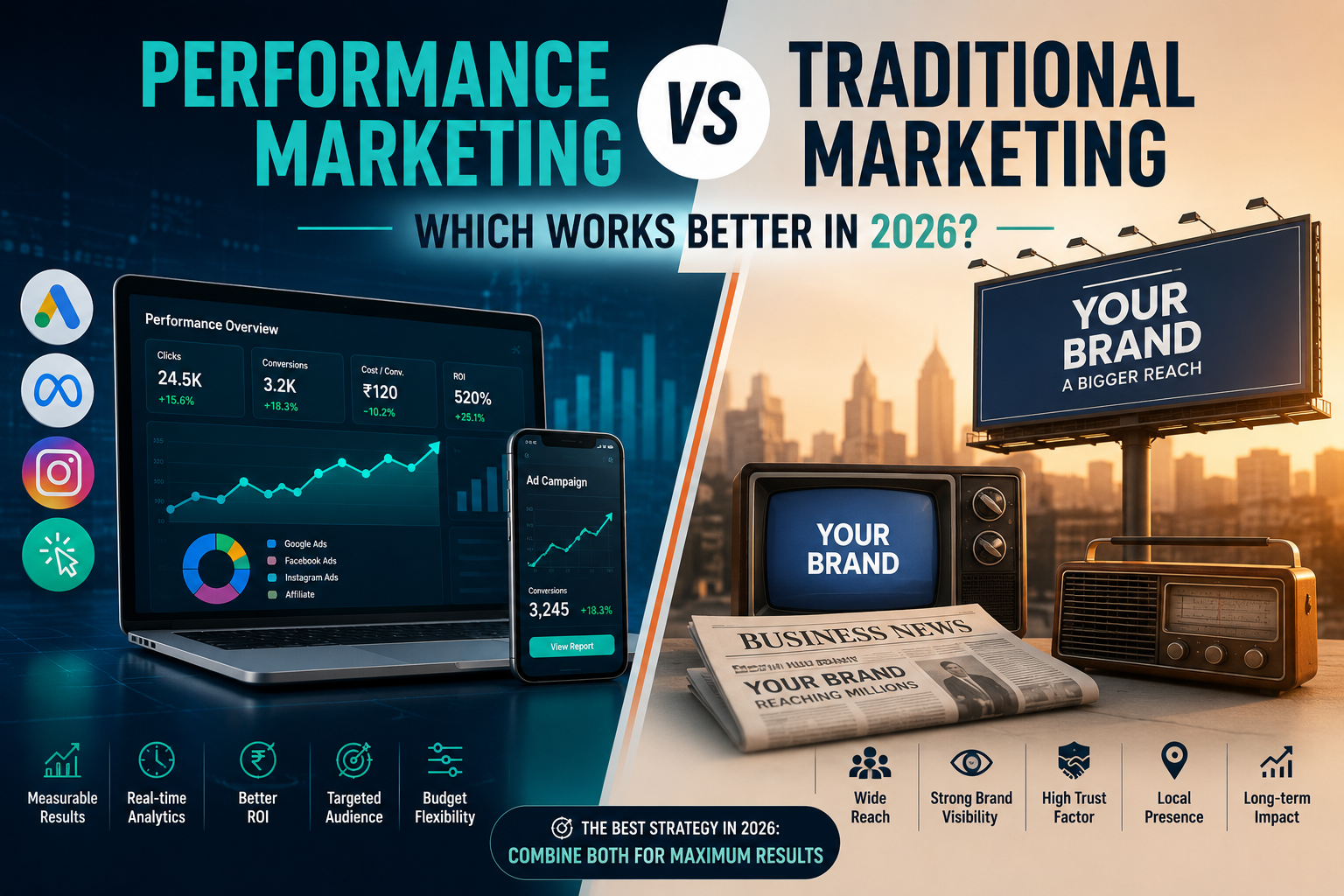
When analysing performance marketing vs traditional marketing, performance marketing appears stronger in terms of flexibility, measurable results, and targeting capabilities.
Modern customers spend most of their time online. They search products on Google, scroll social media platforms, watch YouTube videos, and engage with brands digitally.
Because of this shift in consumer behaviour, performance marketing has become a major growth driver for businesses.
However, traditional marketing has not disappeared. Instead, it has evolved into a supporting strategy for brand awareness and trust-building.
The Best Approach: Combining Both Strategies
The smartest businesses in 2026 are not choosing only one marketing method.
Instead, they combine both approaches strategically.
For example:
- Traditional marketing builds visibility and trust
- Performance marketing converts audiences into customers
A business may use:
- Billboards for local awareness
- Instagram Ads for lead generation
- Google Ads for conversions
- YouTube campaigns for engagement
This hybrid marketing model creates stronger overall results.
Final Conclusion
The comparison of performance marketing vs traditional marketing clearly shows that both strategies offer unique advantages.
Performance marketing stands out because of:
- Better ROI tracking
- Real-time analytics
- Audience targeting
- Faster results
- Budget flexibility
At the same time, traditional marketing remains valuable for:
- Brand awareness
- Public trust
- Offline presence
- Long-term recognition
In 2026, the most effective strategy is not choosing one over the other. Businesses that combine digital performance strategies with strong brand-building efforts are likely to achieve the best results.
Ultimately, the right marketing approach depends on business goals, target audience, and budget.
FAQs
1. What is the main difference between performance marketing vs traditional marketing?
Performance marketing focuses on measurable results such as clicks, leads, and sales, while traditional marketing mainly focuses on brand awareness and offline visibility.
2. Why is performance marketing important in 2026?
Performance marketing in 2026 is important because businesses need measurable growth, advanced targeting, and real-time campaign optimisation.
3. What are the benefits of performance marketing?
The major benefits of performance marketing include better ROI tracking, audience targeting, budget control, scalability, and faster lead generation.
4. Is traditional marketing still relevant in 2026?
Yes, traditional marketing still plays an important role in building trust, local visibility, and long-term brand recognition.
5. Which is better for small businesses: traditional marketing or performance marketing?
Performance marketing is generally more suitable for small businesses because it requires lower budgets and provides measurable results.
6. Can businesses use both marketing methods together?
Yes, combining both methods is often the best strategy because traditional marketing builds awareness while performance marketing drives conversions and sales.